Research overview
Agent Society
Can 94,200 synthetic individuals tell us something about the real world?
I built a synthetic population of 94,200 AI agents to explore a simple question:
Can we create individual synthetic forecasters — each with their own characteristics, environment and information — and produce useful aggregate information from their collective decisions?
The first experiment uses a real-world outcome where this can eventually be tested: Morocco's 2026 legislative election.
The system simulates 94,200 synthetic individuals, distributed across the country and exposed to different demographic, geographic and political environments.
Each individual is treated as an independent forecasting unit.
The objective is not to ask an LLM:
Who will win the election?
It is to construct a population, let thousands of synthetic individuals form their own views, and see what emerges when those views are aggregated.
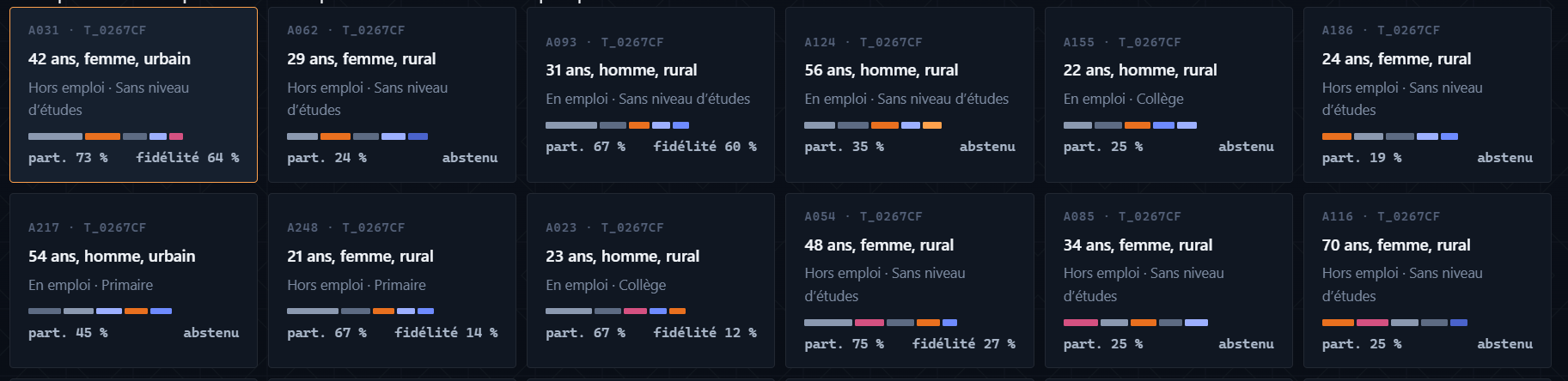
From population to forecast
The framework starts from the individual rather than the national outcome.
1. Build the synthetic population
A population of 94,200 individuals is generated to represent different combinations of characteristics and local environments.
The important unit of the system is therefore not Morocco or even a constituency.
It is an individual.
2. Give each individual a world
Each agent receives information relevant to its own situation: characteristics, geography, local environment and the information available at that point in time.
Two agents living in different places or with different profiles should therefore not necessarily see the same world.
3. Let the individual reason
AI is then used at the individual level.
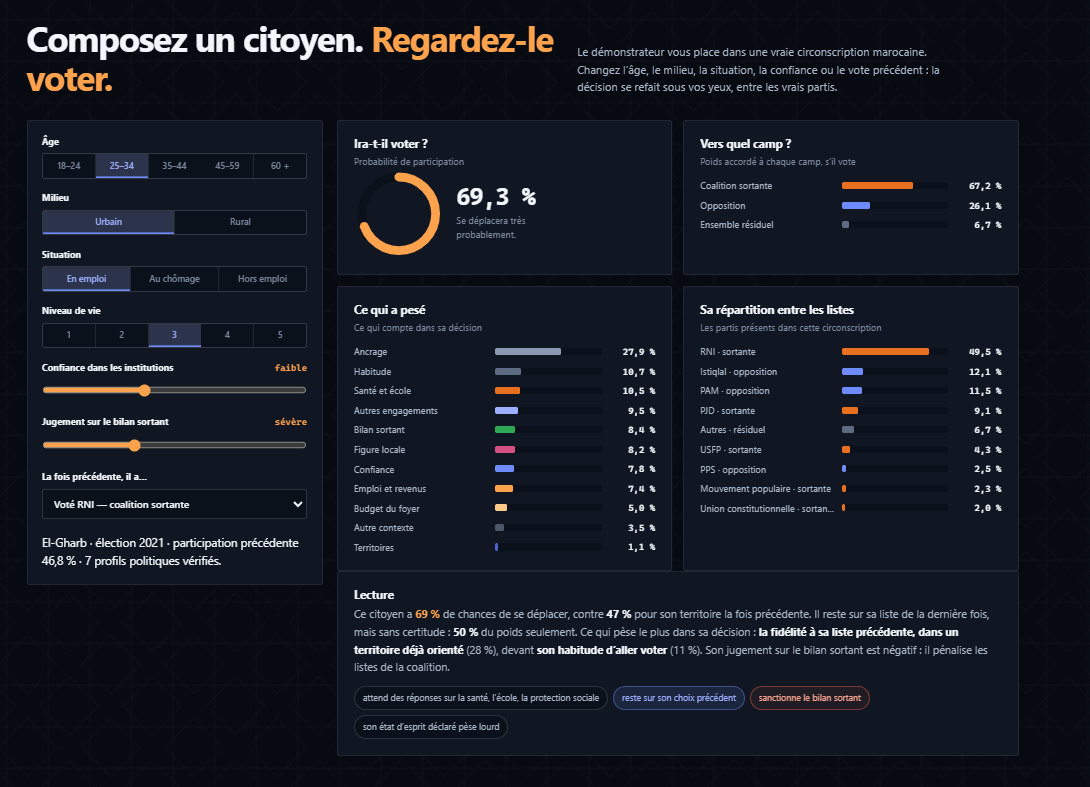
Rather than asking one model to estimate the behaviour of millions of people directly, each synthetic individual forms its own assessment from its own state and context.
This produces tens of thousands of independent synthetic forecasts.
4. Aggregate the population
Those individual outputs can then be aggregated geographically and nationally.
For the election experiment, they ultimately feed into the mechanics of a real 395-seat legislative election.
The national forecast is therefore an emergent output of individual synthetic behaviour rather than the starting assumption.
Why this interested me
Large language models are usually used as centralized prediction systems.
Give the model enough information and ask it for an answer.
I was interested in almost the opposite architecture:
What happens if intelligence is distributed across a synthetic population instead?
A single model may struggle to represent the heterogeneity of a real population.
A synthetic society potentially allows different individuals to react differently to the same event, maintain different beliefs and respond to different local circumstances.
The information may therefore exist not in any one agent, but in the distribution of their individual views.
That is the experiment.
Why an election?
An election provides an unusually useful testing ground.
It involves a large heterogeneous population, strong geographic differences, changing information and thousands of individual decisions that eventually collapse into a single observable outcome.
It also gives the synthetic population something important:
the possibility of being wrong.
The 94,200 individual forecasts can eventually be compared with what real people actually do.
Historical elections can also be used to evaluate earlier versions of the system before the 2026 outcome exists.
The framework
The architecture can progressively become richer.
- Synthetic population
- Individual state and environment
- Context available to each agent
- Individual AI reasoning
- 94,200 individual forecasts
- Geographic aggregation
- Collective forecast
Additional layers can then be introduced.
Agents may receive richer information.
They may interact with other agents.
Information may propagate through social networks.
Individual memory or more sophisticated cognition may change their views over time.
But these are extensions of the same core idea:
Can useful macro information emerge from individually simulated AI agents?
Making the experiment credible
A synthetic society can produce extremely convincing stories while containing very little real information.
So the project also includes simpler forecasting models, historical backtests, controlled information experiments and alternative configurations.
These are not the purpose of the project.
They are the controls.
They help answer whether the synthetic population is actually learning something about the world rather than merely producing plausible behaviour.
If adding individual context changes the forecast, for example, I can deliberately redistribute that context across the wrong individuals and observe whether the signal survives.
If social interaction is later introduced, the population can be compared with the same agents acting independently.
The objective is to understand where the information produced by the synthetic society actually comes from.
Beyond elections
The election is an experimental environment, not the ultimate application.
The same architecture raises a broader possibility:
could thousands or millions of synthetic individuals be used to explore how populations respond to a product, a price change, a policy, a narrative or a new technology before the aggregate outcome is observable?
That is the idea I find most interesting.
Not an AI predicting society from above.
A synthetic society producing a forecast from below.
My contribution
I designed the research framework and built the experimental system with extensive use of AI-assisted development.
The current implementation contains 94,200 synthetic individuals and a complete forecasting environment for Morocco's 2026 legislative election.
The broader experiment is ongoing:
how much real-world information can a population of synthetic AI agents produce?
Experimental research. Synthetic individuals are not survey respondents, and simulated outputs are not treated as measurements of real populations.