Research overview
Global liquidity and changing market regimes
Long-running research into how fiscal policy, central-bank balance sheets, credit conditions and funding markets propagate into asset prices — with particular attention to the moments when established relationships stop working and the underlying regime has changed.
Liquidity is not one thing
I monitor global liquidity less as a number than as a transmission system.
Central-bank balance sheets, M2 or a generic liquidity index can be useful, but they often compress very different mechanisms into the same signal. Markets can have abundant reserves while the price of capital becomes more restrictive. Credit can remain available while duration becomes scarce. A stronger dollar can tighten conditions outside the United States even when the Fed has added no new constraint at home.
I therefore separate five things that are often described simply as liquidity:
Balance-sheet liquidity — reserves, Treasury cash balances, repo markets and the mechanics through which cash moves between the state, banks and markets.
Credit availability — whether banks and capital markets are still willing to extend financing, and at what spread.
Dollar and FX liquidity — where demand for dollars, currency intervention or funding pressure begins to tighten conditions outside the domestic U.S. system.
Duration and the price of capital — sovereign yields, real rates, issuance and the competition for long-term savings. This increasingly includes private demand for capital from areas such as AI infrastructure alongside government borrowing.
Debasement and financial repression — the point at which markets begin to expect policymakers to tolerate inflation, suppress real yields or otherwise make financing constraints easier to absorb.
The distinction matters because these channels can move in opposite directions.
A fall in the Treasury General Account can add cash to the banking system while oil simultaneously pushes inflation expectations and long-term yields higher. Credit spreads can remain tight even as sovereign duration becomes expensive. A central bank can provide ample reserves without making capital cheap.
That is why I am less interested in asking whether liquidity is up or down than in understanding which constraint is binding.
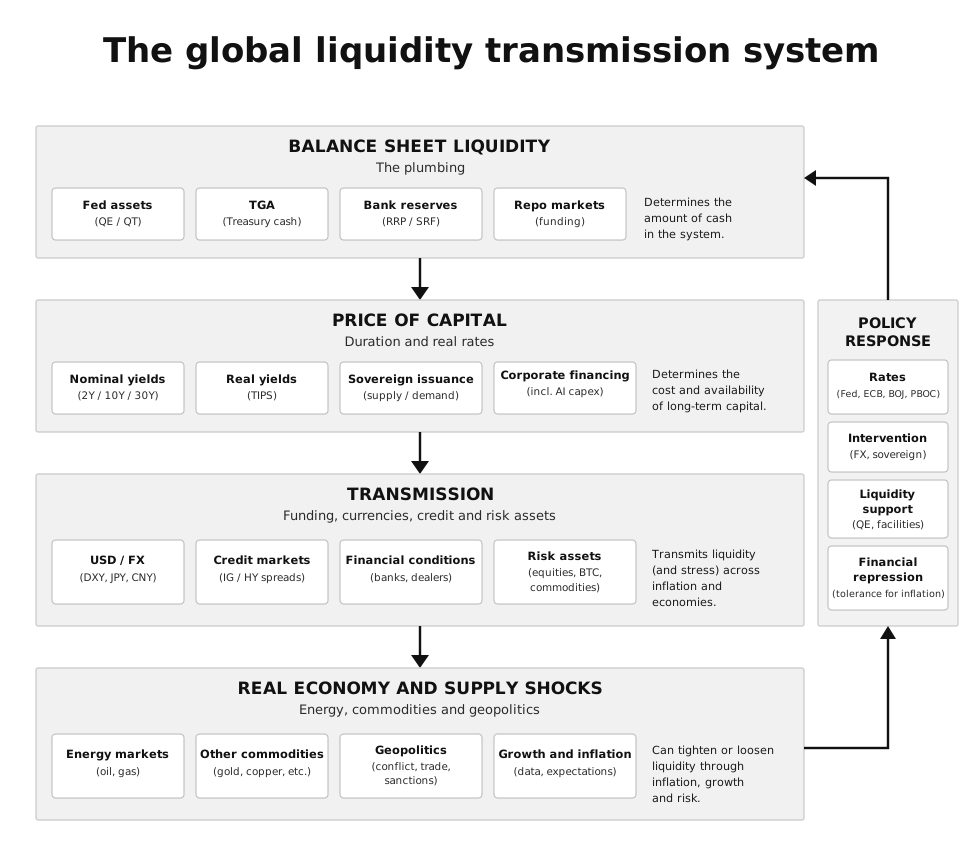
Following the transmission
What I am trying to observe is the transition from one mechanism into another.
An oil disruption matters less to me as an isolated commodity move than when it becomes an inflation shock; an inflation shock matters more when it changes the expected path of policy rates; higher rates matter more when they begin to alter sovereign-duration demand, credit availability, currencies or leveraged positions.
The same applies in reverse. A decline in Treasury cash can inject liquidity into the banking system, but whether that becomes useful risk liquidity depends on what is happening simultaneously to real rates, credit and the dollar.
So I track the chain rather than any individual indicator:
physical or policy shock → funding and capital markets → currencies and rates → credit → risk assets.
The interesting moments are usually the ones where an established relationship stops working.
If reserves rise but Bitcoin and equities continue to weaken, something else is dominating the liquidity impulse. If oil rises but long yields stop responding, the market may have changed its inflation interpretation. If long yields rise while credit remains calm, the problem is still the price of capital; if spreads and funding markets begin to break as well, it has become something different.
Those transitions are what I am looking for.
What makes me change my mind
I do not try to update the regime every time a market moves.
I maintain a set of competing explanations and look for evidence large enough to distinguish between them: thresholds being crossed, several markets confirming the same mechanism, a change in policy, or a transmission channel appearing that was previously absent.
A higher Treasury yield is information. Higher Treasury yields together with widening credit spreads, dollar funding pressure and weaker risk assets are a different state of the system.
The purpose of the monitor is therefore not prediction for its own sake. It is to make the current hypothesis explicit, define what would invalidate it, and notice early when the evidence begins to describe a different regime.
The question is not whether liquidity is rising or falling. It is which constraint is binding.