Research overview
Building cross-asset decision systems that can reason beyond the first move
I have been building a cross-asset decision system to make financial judgement more explicit, testable and adaptive.
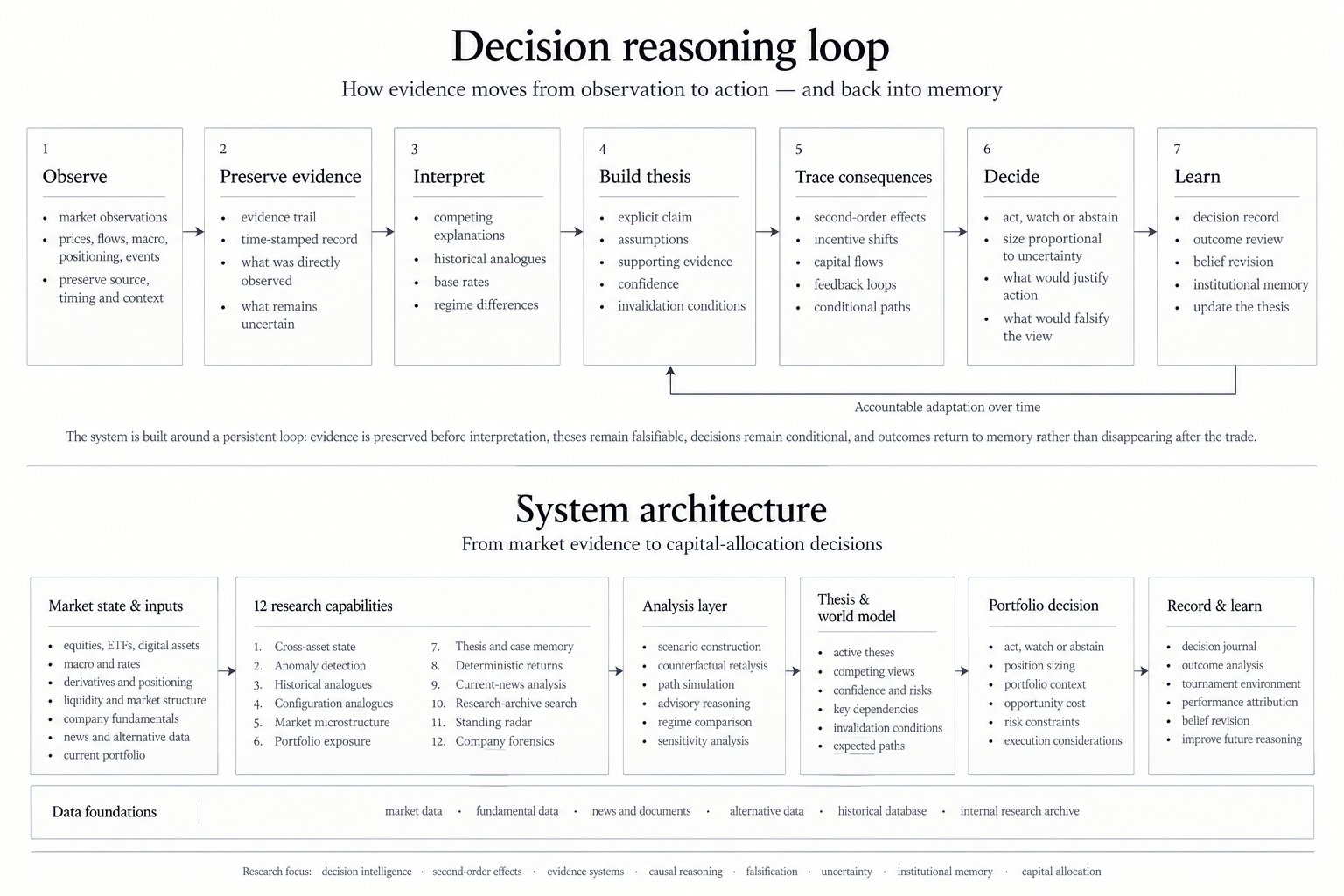
The system combines a 12-capability research layer with scenario analysis, counterfactuals, path simulation, thesis memory, portfolio context, deterministic risk controls and a decision journal. It can move from a market observation to a structured investigation, maintain competing explanations, test them against history, trace their consequences through a portfolio and preserve what was believed before the outcome was known.
Its purpose is not to produce more predictions.
It is to improve the reasoning between information and action.
The problem
Financial decisions are rarely limited by access to information.
The harder problem is deciding what matters, how evidence from different markets relates, which explanation deserves weight and when a plausible thesis has become strong enough to justify action.
Most analytical tools fragment that process.
Equities sit on one screen, rates on another. Macro is separated from positioning. Company fundamentals are separated from liquidity. Market commentary is separated from the portfolio that ultimately has to absorb the consequences.
Yet some of the most useful information exists precisely in the relationship between those things.
Analysis also tends to compress uncertainty too quickly.
A market move is assigned a cause. The cause becomes a narrative. The narrative gradually hardens into conviction.
Evidence consistent with the view accumulates around it; contradictory evidence becomes easier to dismiss.
This work starts from a different premise:
Judgement improves when the reasoning around a decision remains observable, challengeable and revisable.
That requires more than an AI model or a stream of market data.
It requires a system that can connect markets, preserve evidence, maintain memory, attack its own explanations and record what would prove its current view wrong.
The research machinery
The system currently exposes twelve specialised research capabilities.
They cover:
- cross-asset state — relationships, divergences and changes across markets;
- anomaly detection — unusual behaviour worth investigating;
- historical analogues — prior episodes resembling the current one;
- configuration analogues — similar combinations across several markets simultaneously;
- market microstructure — funding, open interest, spread, depth, liquidations and participant behaviour where available;
- portfolio exposure — holdings, overlap, concentration, liquidity and opportunity cost;
- thesis and case memory — active views, counter-cases, falsifiers and unresolved questions;
- deterministic returns and market-state calculations;
- current-world search;
- research-archive search;
- standing radar and attention ranking;
- company forensics — connecting market behaviour with reported fundamentals and corporate evidence.
Around that core sit additional experimental layers for scenario construction, counterfactual analysis, path simulation, advisory reasoning, deterministic risk and decision journaling.
They do not all have the same maturity and they are not all allowed into the live decision path.
That boundary matters.
The existence of sophisticated machinery is evidence of engineering capability.
It is not, by itself, evidence of predictive or economic advantage.
A connected view of the market
The system treats the market as a connected state rather than a collection of isolated instruments.
It brings together evidence from equities, ETFs, digital assets, macro conditions, derivatives, liquidity, positioning, company fundamentals, news and the existing portfolio.
A move can therefore be evaluated as a configuration rather than as a price change in isolation.
The same equity decline may mean something very different when yields are rising, the dollar is strengthening and liquidity is deteriorating than when rates are falling and defensive assets are rallying.
The same crypto move may contain very different information depending on funding, open interest, depth, liquidations and participant concentration.
The question is therefore not simply:
What moved?
but:
What else moved with it, what disagreed, and how unusual is this configuration?
Analogies, not anecdotes
Historical comparison becomes useful only when similarity is defined explicitly.
The analogy engines search for previous market states that resemble the present across one or several dimensions.
They can compare individual asset episodes, joint market configurations and cross-asset states; estimate how unusual a configuration is; remove overlapping historical neighbours; and examine what happened over subsequent horizons.
The output is not:
This happened in 2008, therefore it will happen again.
It is a distribution of conditional outcomes.
How frequently did the move continue?
How frequently did it reverse?
How wide was the subsequent distribution?
Which characteristics of the current case are absent from its historical neighbours?
An analogy therefore provides base-rate evidence, not a causal answer.
Beyond the first move
The first-order question asks what an event means now.
The more interesting question is often:
What does it change?
Which incentives move?
How do other participants respond?
Where does capital migrate?
Which financing constraints become binding?
What feedback loops appear?
A rate decision, supply shock or liquidity event rarely remains isolated. It propagates through positioning, financing conditions, corporate behaviour, risk appetite and expectations.
The system therefore tries to represent a thesis not only as:
event → interpretation
but as:
event → mechanism → participant response → capital flow → feedback → possible subsequent state
Scenario analysis and path simulation make those conditional chains explicit.
Counterfactual analysis attacks them from the other direction:
What would have to be true for this explanation to be wrong?
A thesis is a stateful object
A thesis is not stored simply as prose.
It maintains:
- an explicit claim;
- supporting evidence;
- assumptions;
- competing explanations;
- confidence;
- unresolved evidence;
- invalidation conditions;
- subsequent revisions.
New information therefore does not merely accumulate around the thesis.
It can strengthen it.
It can expose a hidden dependency.
It can activate a counter-case.
Or it can invalidate the original explanation entirely.
This makes belief revision part of the architecture.
The objective is accountable adaptation: being able to reconstruct why a view changed, whether it changed quickly enough and whether the revision followed evidence or merely followed price.
From a question to an investigation
A research question is first decomposed into the capabilities needed to answer it.
The system may call the cross-asset state, analogy engines, active thesis memory, portfolio exposure, microstructure evidence, company data, live news or prior research.
A deeper investigation can then seek additional evidence, compare regimes, construct scenarios, attack its emerging explanation and surface the facts on which the conclusion actually depends.
The system does not require every investigation to produce an answer.
A valid result can be:
act
watch
abstain
or simply:
the available evidence does not yet discriminate between the competing explanations.
That ability to abstain is part of the architecture.
Memory as decision infrastructure
Markets generate enormous quantities of analysis and remarkably little durable memory.
Research disappears into conversations, dashboards and daily notes.
Assumptions behind forecasts are forgotten.
Past decisions become remembered through their outcomes rather than through the information that was available when they were made.
The system preserves theses, cases, analogues, rejected explanations, unresolved questions, decisions and later outcomes across research sessions.
That changes the role of memory.
It is no longer an archive.
It becomes part of the reasoning process.
New evidence can be compared with what was previously believed.
A recurring pattern can be recognised.
A supposed surprise can be compared with forgotten precedent.
And hindsight cannot as easily rewrite what appeared uncertain beforehand.
From research to capital allocation
The final purpose is better capital-allocation judgement.
The system can compare:
hold · add · reduce · exit · hedge · rotate · wait · remain in cash
An investment is not evaluated as though it existed independently of the portfolio.
Exposure, overlap, liquidity, costs, capacity, invalidation and alternative uses of capital all matter.
Research can inform the decision.
It cannot bypass deterministic risk controls or grant itself authority over capital.
The distinction between reasoning and authority is deliberate.
The league as a living laboratory
I also built a tournament environment to make the decision process observable.
Different strategies, theses, scoring models and decision policies are placed under common rules and asked to act on the same opportunity set.
They can compete across equities, ETFs and digital assets, across different horizons and market regimes, and against deliberately simple alternatives.
Complexity receives no automatic credit.
A sophisticated model still has to justify itself against simpler behaviours such as trend, value, risk-control, waiting or cash.
Historical tournaments ask whether an apparent advantage survives point-in-time reconstruction, unseen periods, costs, liquidity and adversarial review.
Forward-shadow leagues answer a different question.
They freeze what the system knew before the outcome, record the decision and its alternatives, and wait for the market to resolve them.
That creates a repeated experimental loop:
observe → interpret → decide → freeze → resolve → compare → learn
The league is therefore not primarily a leaderboard.
It is a laboratory for studying judgement under uncertainty.
A losing strategy, broken thesis or sophisticated component that fails to outperform a simpler benchmark is still useful evidence.
Failure becomes part of the system's memory.
And importantly:
A tournament winner remains a research candidate, not an automatic trading signal.
It must survive independent replay and forward evidence before its claim can be strengthened.
Learning from decisions
The system is designed to preserve more than successful calls.
It records decisions, abstentions, rejected alternatives, overrides and null results alongside subsequent outcomes.
That makes several distinctions possible:
Was the outcome right for the reason originally expected?
Was the thesis correct but poorly timed?
Was the result profitable despite bad reasoning?
Was the thesis invalidated but retained too long?
Would another decision available at the time have produced a better outcome?
This is where memory closes the loop.
The objective is not simply to accumulate performance statistics.
It is to learn which forms of reasoning deserve more weight the next time the system encounters a similar state.
What the work is testing
The broader research question is whether a cross-asset decision system can improve judgement without pretending to eliminate uncertainty.
Can it discover consequential relationships before they become obvious?
Can it distinguish a useful historical analogue from a superficial resemblance?
Can it trace second-order effects rather than merely explain the first move?
Can it preserve disagreement when the evidence remains ambiguous?
Can it recognise that a thesis has failed rather than quietly rewrite it?
And can repeated decisions make the system itself better at deciding what deserves attention, what deserves conviction and when the correct action is simply to wait?
The existence of powerful machinery is not the answer.
Engineering capability, analytical usefulness and demonstrated investment edge are three different claims.
The work is ultimately about determining where one genuinely becomes the next.
Research focus
Cross-asset decision intelligence · Second-order effects · Historical analogues · Regime awareness · Evidence systems · Counterfactual reasoning · Path simulation · Falsification · Market structure · Portfolio context · Comparative tournaments · Institutional memory · Capital allocation
Status
System in continuous use · 2025–26.
The research estate contains substantial executable machinery, with different components at different stages of maturity.
The system continues to evolve through live investigations, historical tournaments, forward-shadow decisions, outcome review and repeated testing across new market regimes.
Its development follows one principle:
A useful decision system should not merely remember its conclusions. It should understand the market around them, preserve the evidence beneath them and know when it has reason to think again.
Related research
AI inference markets and execution economics — A market-structure investigation into provider routes, pricing and execution quality.
Synthetic AI agents and collective forecasting — A separate experiment in aggregating individual synthetic forecasts and testing the resulting signal.
About the author
Amine El Afrit is a Casablanca-based finance executive working across strategic finance, capital allocation, business transformation and operating-model design. His independent research explores AI-driven business-model change, markets and decision systems.