Research note
When intelligence becomes abundant
What customer service could become beyond the human-versus-AI debate.
Most discussions about AI in customer service still revolve around the same question: should an interaction be handled by a human, by AI, or by some combination of the two?
I increasingly think that this framing is too narrow.
If intelligence becomes abundant on both sides of the relationship, the harder problem may no longer be who understands the situation or produces the answer. It may be who can turn intent into an authorized, verifiable outcome.
That points toward a different future for customer service: not simply a more automated interface between a customer and a company, but an operating layer capable of turning human and machine decisions into real-world outcomes.
The future of customer service may be less about who provides the intelligence and more about who makes the resulting decision real.
In September 2024, I started playing with agentic AI and discovering what it actually was by building things with Replit.
The timing was interesting. Replit had just introduced Agent, initially in early access: instead of simply helping you write code, it could configure everthing for the user and take an application from an idea towards something that actually worked.
I wasn't approaching this as a software engineer, but I wanted to understand what happened when someone like me could describe an objective to software and increasingly let the software work out how to get there. It was quite incredible back then!
Around the same time, I was thinking about a broader question around customer experience. If AI became capable of understanding a problem, finding a solution and acting on it, why should customer service still begin with a customer contacting a company?
I was working on an idea I called a Neural Network, or sometimes a CX Travel Network, for travel and hospitality. One of the examples I used was deliberately simple: a hotel overbooking. The system would detect the overbooking itself, understand that a customer had been affected, generate suitable alternatives, contact the customer proactively and execute the rebooking once an option had been selected. At the time, I mostly thought about this as a better way of doing CX. But I’m not so sure now, revisiting this idea more than two years later.
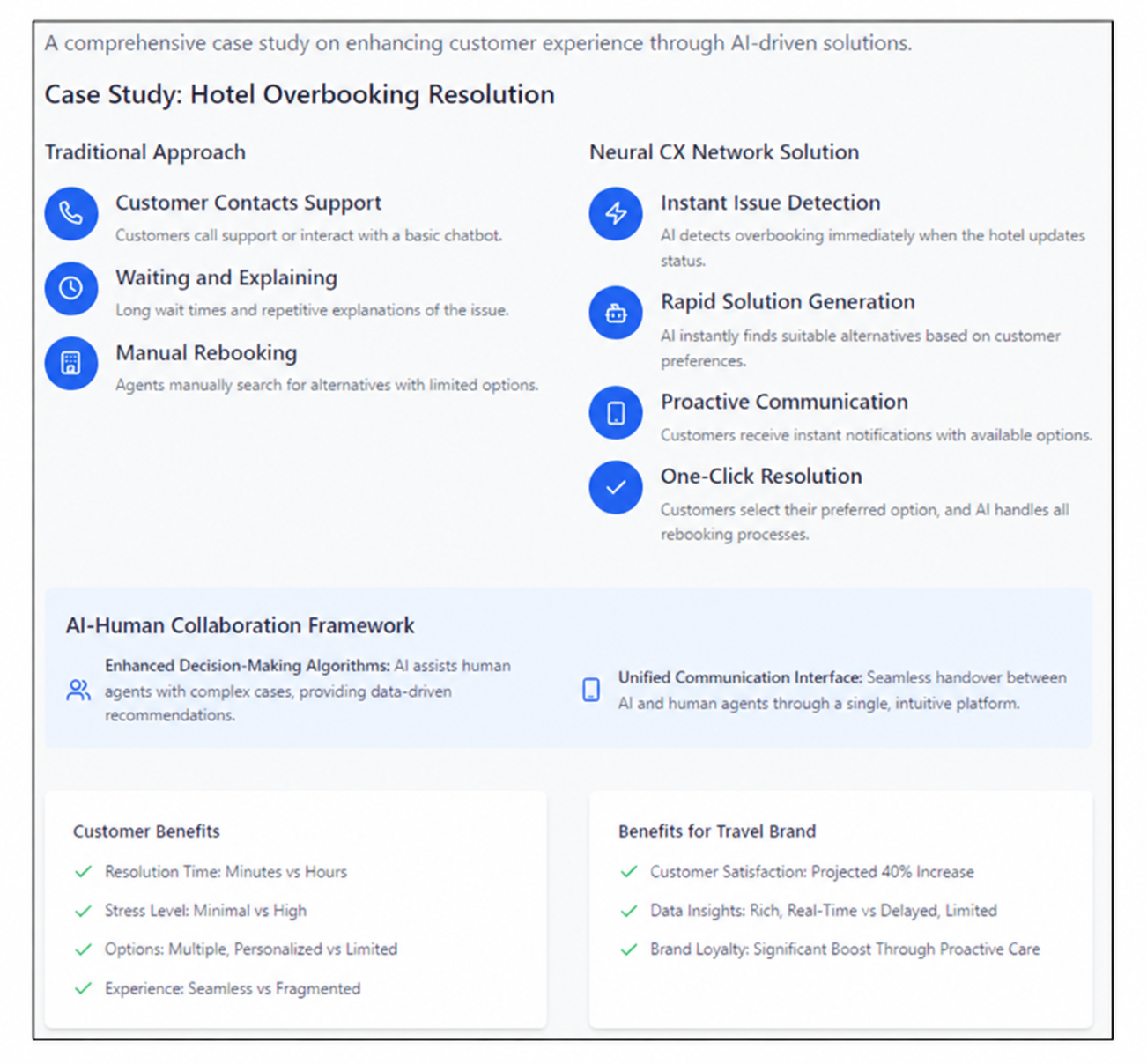
The thing that changed is the price of intelligence
What has changed enormously since then is the cost of intelligence. Reading information, understanding a situation, comparing alternatives, applying preferences, generating a recommendation or navigating a software interface are all becoming dramatically cheaper. The models are improving, of course, but the deeper change is that intelligence itself is becoming something that can be applied almost everywhere, at very low marginal cost.
That matters because a large part of the customer-service industry was built around the opposite assumption. Understanding a problem was expensive. Somebody had to listen to the customer, recover the context, interpret the company's policies, search through several systems and work out what should happen next. Because human judgement was scarce, entire operating models were designed around allocating it efficiently: queues, routing, skills, tiers, offshore locations, occupancy, average handling time.
The first response to AI has naturally been to make that model more efficient. Give the human agent a better copilot. Automate simple contacts. Improve self-service. Reduce handling time. Those are real improvements, but they still assume that the interaction itself remains the basic unit of the system.
I am increasingly unsure that this is where the larger change sits.
If intelligence becomes sufficiently cheap and abundant, then understanding the problem and generating a sensible answer may no longer be the hard part. Take the hotel example again. There is no particular reason why the intelligence required to decide that I should move from Hotel A to Hotel B needs to sit inside a customer-service department. My own agent could eventually know my itinerary, my preferences, how much I paid, whether I care about breakfast, how far I am willing to move and how much additional cost I would accept. The hotel may have its own systems. The booking platform may have another agent. Any of them may be perfectly capable of working out a good answer.
What remains difficult is making that answer real
Does the replacement room actually exist? Can the original reservation be cancelled? Who has the authority to make the change? And what happens if something goes wrong?
This is where the old CX Travel Network idea starts to look more interesting to me than it did in 2024. The network does not need to be the smartest participant in the system. Intelligence may eventually be everywhere. Its value comes from connecting intelligence to reality: seeing that something has changed, understanding what outcome is required, coordinating the different participants, obtaining the necessary authority, executing the actions and dealing with the exceptions when the normal path breaks.
Today, a human interaction often acts as the glue holding all of this together. The human understands the situation, moves between systems, applies judgement and gets the different pieces to line up. If intelligence becomes abundant, much of that reasoning can happen automatically, but the need for coordination, authority and execution does not disappear. In some ways, it becomes more important because there are now many more intelligent actors capable of proposing what should happen.
The same structure appears almost everywhere once you start looking for it. For years, CX has been defined mainly as the interface between a customer and a company. I am not sure that definition survives a world in which both customers and companies have their own intelligence. The interface may become much less important than the infrastructure underneath it.
That leads me to a broader interpretation of what an Operating Layer of Global Business could actually mean: It would not simply be a larger customer-service platform, and it would not be an AI layer placed on top of existing workflows. It would be much bigger and far greater: it's the layer through which human and machine intentions become real business outcomes. A layer that can understand enough context to know what is trying to happen, authenticate the parties involved, determine what they are allowed to do, coordinate across systems and organizations, apply policy, execute the relevant actions, handle the exceptions and verify that the expected outcome actually occurred. To me, this is much more valuable than the current setup.
I believe that once intelligence is no longer the scarce resource around which the whole architecture is organized and when it becomes one of the inputs, the scarce assets become access to authoritative state, permissions, trust, orchestration, execution and accountability.
Looking back, I think that is what I was beginning to sketch in September 2024 without really having the language for it. I thought I was drawing a more intelligent customer journey, but I think I may have been drawing an early version of a much larger system: one designed for a world where intelligence is abundant and where businesses still need a trusted layer capable of turning decisions into actions and actions into real-world outcomes. I'm very curious to see if CX will finally head toward that idea and evolve in this direction over the next few years.
Related research
Personal AI agents and customer experience — Field experiments on what changes when agents research, compare and decide on the customer’s side of the relationship.
AI agents and the changing customer journey — A working note on consumer agents, customer inertia and the implications for enterprises and CX operators.
About the author
Amine El Afrit is a Casablanca-based finance executive working across strategic finance, capital allocation, business transformation and operating-model design. His independent research explores AI-driven business-model change, markets and decision systems.